These checks are particularly important in disaster relief, military field operations, firefighting, and temporary medical support. A small defect discovered before deployment can often be corrected more easily than a problem identified after the shelter is occupied.
This guide provides a practical pre-use inspection process for emergency shelter teams. It covers site readiness, inflation checks, operational requirements, and deployment handover records so that each shelter can be inspected consistently before it enters service.
A pre-use inspection should begin before inflation. Teams should first confirm that the delivered shelter matches the approved equipment list and that all components required for the planned operation are available.
Do not rely on a visual check of the fully inflated structure alone. Some defects, missing accessories, or connection problems are easier to identify while the tent is still packed or partially assembled.
The initial inspection should cover the following areas:
Product identification: Confirm the model, dimensions, configuration, and intended application against the deployment order.
Outer fabric: Look for cuts, punctures, abrasion, damaged coating, loose stitching, and signs of previous repairs.
Air columns: Inspect visible air-beam surfaces, seams, valves, protective covers, and connection areas for damage or deformation.
Doors and windows: Check zippers, fasteners, mesh panels, opening mechanisms, and protective covers.
Ground protection: Examine the groundsheet or floor for holes, contamination, moisture damage, and worn areas.
Accessories: Confirm that the correct pump, hoses, gauges, anchors, ropes, repair materials, and other specified components are included.
Material specifications should also be checked against the approved product documentation. For example, the JLF inflatable squad tent product page identifies PVC-coated 600D polyester Oxford cloth for the outer fabric, 210D Oxford cloth for the inner lining, PVC mesh-coated airtight fabric for the air columns, and double-sided PVC mesh-coated fabric for the ground cover. These details provide useful inspection reference points for the corresponding model, but should not be assumed to apply to every tent configuration.

Teams should record any defects before inflation. A damaged valve, missing anchor, or questionable seam should not be treated as a minor issue simply because the tent appears usable. If a component does not meet the manufacturer's requirements, stop the inspection and obtain technical confirmation before proceeding.
A simple receiving record containing photographs, component quantities, and inspection notes can also help identify whether damage occurred during transportation, storage, or previous use.
Once the equipment has passed its initial inspection, the deployment team should verify that the selected location can accommodate the complete shelter configuration. The actual footprint is larger than the visible tent dimensions because the setup may also require anchoring points, guy lines, entrances, service connections, and safe working clearance.
Start by comparing the available ground area with the manufacturer's layout drawing. Confirm that the tent can be positioned without obstructing vehicle routes, emergency exits, nearby structures, or other response facilities.
Several site conditions should be checked before inflation:
Ground condition: Confirm that the surface is sufficiently stable and free from sharp objects, debris, and obstacles that could damage the floor or fabric.
Drainage: Check for standing water, surface runoff, low-lying areas, and locations where rainwater could collect around or beneath the shelter.
Available clearance: Make sure there is enough space for the full structure, approved anchoring arrangements, and inspection access.
Access and evacuation: Keep entrances, exits, and emergency routes unobstructed.
Vehicle access: Confirm that response vehicles, ambulances, supply vehicles, and maintenance equipment can reach the required areas.
Environmental hazards: Identify nearby electrical lines, overhead obstructions, unstable objects, fire hazards, and other site-specific risks.
Ground conditions deserve particular attention. A surface that appears level may still have poor drainage or unsuitable soil for the specified anchoring system. Teams should not assume that ordinary ground stakes will provide adequate holding strength in every location. The anchor type and installation method must follow the approved deployment plan and manufacturer's instructions.
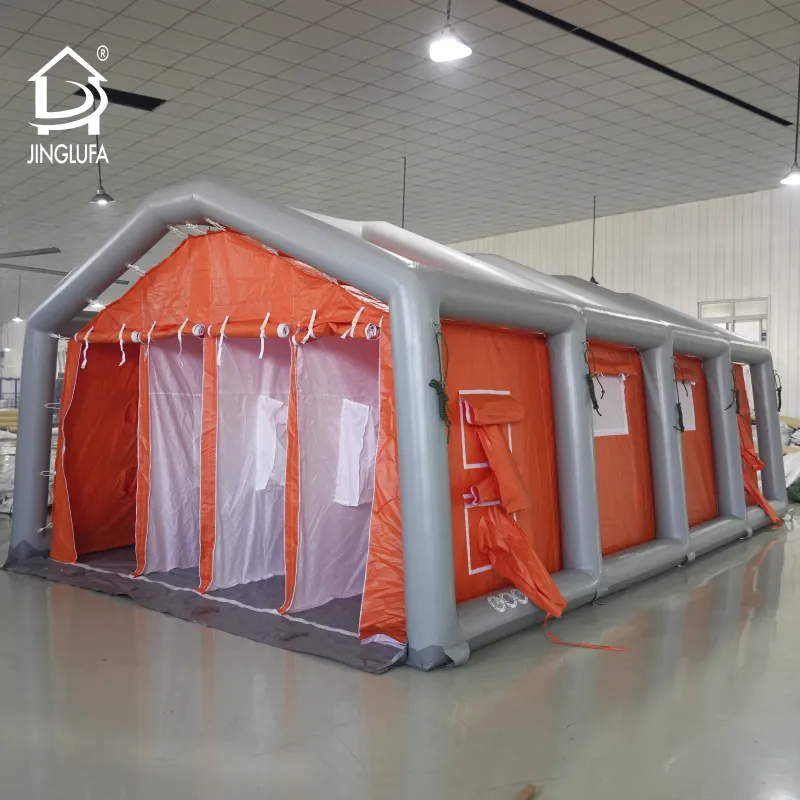
For teams preparing an inflatable military tent, the available footprint should also account for the movement of personnel and the transportation of equipment around the shelter. Ropes and anchoring points should not create unnecessary trip hazards or block access for emergency responders.
International humanitarian guidance also emphasizes suitable site access, drainage, and the surrounding environmental conditions when planning temporary shelter locations. The UNHCR Emergency Shelter Solutions and Standards provides further reference for assessing shelter suitability in different emergency environments.
Before inflation begins, the team leader should confirm that the location is ready, the complete footprint is available, and the access and evacuation routes remain clear.
Inflation is a critical stage of deployment because it reveals problems that may not be visible during the initial equipment inspection. The pump, hoses, valves, connectors, and pressure-measuring equipment should all be checked before the inflation process starts.
First, confirm that the pump is compatible with the tent and that the hose fittings connect correctly to the designated inflation valves. Check power cables, electrical connections, and the availability of backup power where required. Keep equipment positioned so that cables and hoses do not interfere with personnel movement.
During inflation, the team should follow the manufacturer's sequence rather than opening or pressurizing all air chambers without reference to the product instructions.
Important observations include:
Air distribution: Check whether the designated air chambers expand evenly and whether the overall structure takes the expected shape.
Valve connections: Look for loose fittings, damaged seals, incorrect connections, or unusual air leakage.
Fabric tension: Observe whether the outer cover expands without abnormal folds, excessive tension, or localized deformation.
Structural alignment: Confirm that the tent remains properly positioned and that the air columns are not twisted or obstructed.
Pressure readings: Record the gauge readings according to the manufacturer's specified inspection procedure.
Equipment condition: Monitor the pump, hoses, cables, and connectors for overheating, damage, or abnormal operation.
There is no universal inflation pressure suitable for every inflatable shelter. Different structures, air-column designs, materials, and operating conditions can require different pressure ranges. Teams must use the approved pressure values and limits supplied for the exact model.
After the tent reaches its specified operating condition, an air-retention check should be carried out. Record the initial reading, inspection time, ambient conditions, and subsequent readings at the intervals required by the manufacturer's instructions.
Visual inspection should continue throughout this process. Listen for unusual air leakage and examine accessible seams, valves, and air-column connections. A noticeable pressure change should be investigated rather than automatically corrected by adding more air.
Temperature changes may also affect pressure readings. Therefore, teams should record relevant environmental conditions when comparing measurements and should use the manufacturer's evaluation criteria rather than relying on an arbitrary pressure-drop percentage.
If abnormal deformation, leakage, damaged fittings, or readings outside the approved limits are detected, the tent should not be released for normal operation until the issue has been assessed and resolved.
Once the inspection is complete, the team should document the results and keep the pump, compatible repair materials, and relevant spare components accessible for subsequent maintenance.
An inflatable shelter may be used for several emergency functions, but the final inspection should reflect its actual operational purpose. A shelter intended for firefighting support does not necessarily require the same interior arrangement, access control, or environmental conditions as a temporary medical facility.
For rescue and firefighting operations, teams should pay particular attention to equipment access, personnel movement, communication facilities, and the positioning of the entrance. The shelter should not obstruct firefighting equipment, rescue vehicles, or the movement of emergency personnel.
Doors and windows should be checked for proper operation, and any designated ventilation openings should remain usable. Where electrical equipment, lighting, or other utilities are installed, their connections and cable routes should be inspected before the shelter is occupied.

For this type of application, an inflatable rescue tent should be inspected according to its designated emergency function. Teams should confirm that the internal space, access arrangements, and supplied accessories support the actual tasks planned for the deployment.
For temporary medical operations, the checklist should extend beyond the physical structure. The internal layout needs to support patient movement, staff access, equipment placement, privacy, and appropriate hygiene practices.
Before accepting the shelter for clinical use, check the following:
Whether the entrance and internal routes allow patients and medical personnel to move safely.
Whether the floor and internal surfaces are suitable for the intended cleaning and disinfection procedures.
Whether the ventilation arrangement is appropriate for the planned medical activity.
Whether lighting and electrical connections support clinical equipment where required.
Whether separate areas are needed for patient reception, assessment, treatment, supplies, or other functions.
Whether hand hygiene facilities and waste-handling arrangements can be provided.
A medical shelter should not be accepted for clinical use solely because its structure is stable. The facility must also meet the operational requirements of the medical team and applicable public health procedures.

For a medical deployment, the inflatable medical tent should be checked together with its internal equipment and facility layout. Patient flow should be planned before furniture, beds, medical devices, and supplies are positioned.

The World Health Organization's Classification and Minimum Standards for Emergency Medical Teams provides guidance on site assessment, facility configuration, and sequential establishment of medical services. These principles are useful when preparing temporary medical facilities for emergency operations.
The key distinction is that structural readiness and operational readiness are separate requirements. Both must be confirmed before the shelter is handed over for its intended purpose.
A documented handover ensures that the personnel responsible for using the shelter understand its condition, configuration, inspection results, and any remaining restrictions. This is particularly important when installation and daily operation are handled by different teams.
The handover should be completed only after the physical inspection, inflation checks, access verification, and internal arrangement have been reviewed.
A practical deployment record can include the following information:
| Record Item | Information to Document |
|---|---|
| Tent identification | Model, identification number, dimensions, and configuration. |
| Site inspection | Deployment location, ground condition, drainage, access, and identified hazards. |
| Component inspection | Fabric, air columns, valves, doors, windows, pump, and accessories. |
| Inflation results | Pressure readings, inspection times, air-retention observations, and test results. |
| Anchoring and access | Approved anchoring arrangement, entrance clearance, and emergency access routes. |
| Operational configuration | Intended use, internal layout, utilities, and installed equipment. |
| Outstanding issues | Defects, corrective actions, maintenance requirements, and operating restrictions. |
| Handover confirmation | Inspection personnel, receiving team, date, and approval status. |
Photographs should be attached where they help demonstrate the completed installation, the condition of important components, or the location of specific access points. Pressure records and inspection notes should also be retained for future reference.
During the handover, the incoming team should be shown the inflation and deflation arrangements, approved operating limits, emergency procedures, and locations of repair equipment. They should also understand which conditions require the shelter to be taken out of service.
Any unresolved safety-critical defect should prevent operational release. If a minor issue is accepted under an approved procedure, it should be clearly recorded together with the responsible person and the required corrective action.
Finally, the inspection process should continue after handover. Changes in weather, ground conditions, shelter relocation, repeated use, or maintenance work may affect the condition of the structure. Teams should therefore establish a suitable reinspection schedule based on the manufacturer's instructions and operational requirements.
No. Inflation time only describes the process of expanding the air-supported structure. Total deployment also involves equipment inspection, site preparation, positioning, anchoring, air-retention verification, internal arrangement, and final operational checks. Emergency teams should evaluate the complete process rather than use inflation time alone as the measure of readiness.
After relocation, teams should repeat the relevant site and structural inspections. Check the ground condition, drainage, access routes, anchoring points, fabric, seams, valves, air columns, and connections. The shelter should also undergo the inflation and air-retention checks specified by the manufacturer. Previous inspection records should not automatically be treated as approval for a new location.
Pressure limits, inflation sequences, air-retention acceptance criteria, anchoring arrangements, wind operating limits, approved repair procedures, and maintenance requirements must be verified against the instructions for the specific model. These values and procedures can vary between different inflatable structures. If documentation is missing or a test result is unclear, obtain technical confirmation before putting the shelter into service.
A reliable inflatable shelter deployment depends on more than rapid inflation. Equipment condition, site readiness, air-retention performance, access arrangements, and operational configuration must all be checked before the structure is released for use.
For emergency response teams, a standardized pre-use checklist makes inspections more consistent, improves communication between installation and operating personnel, and helps identify problems before they affect field operations.
By combining model-specific manufacturer instructions with documented inspection and handover procedures, organizations can manage their inflatable shelters more systematically and prepare them for their intended emergency applications.