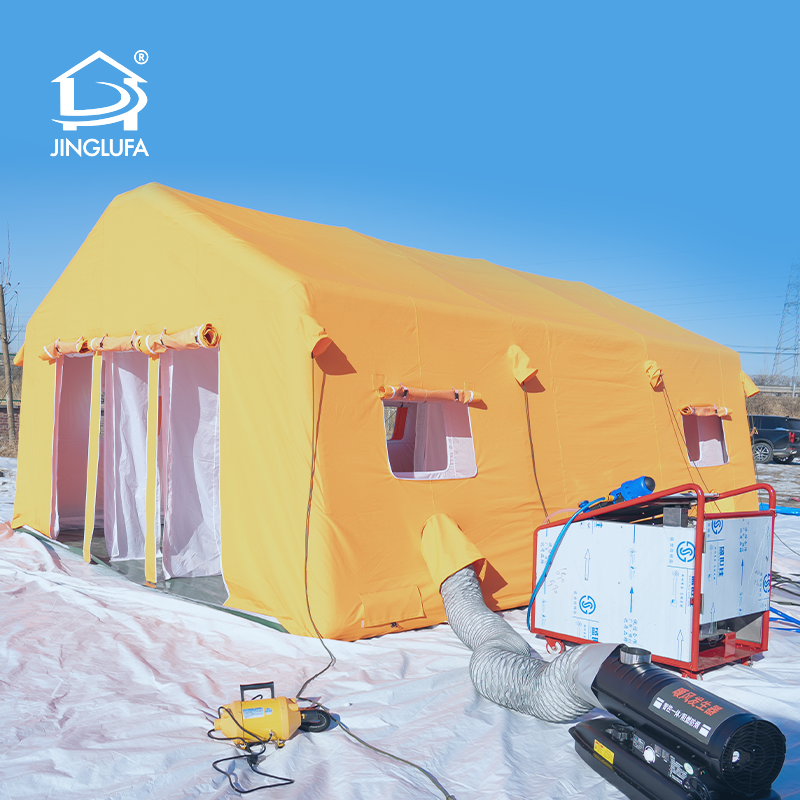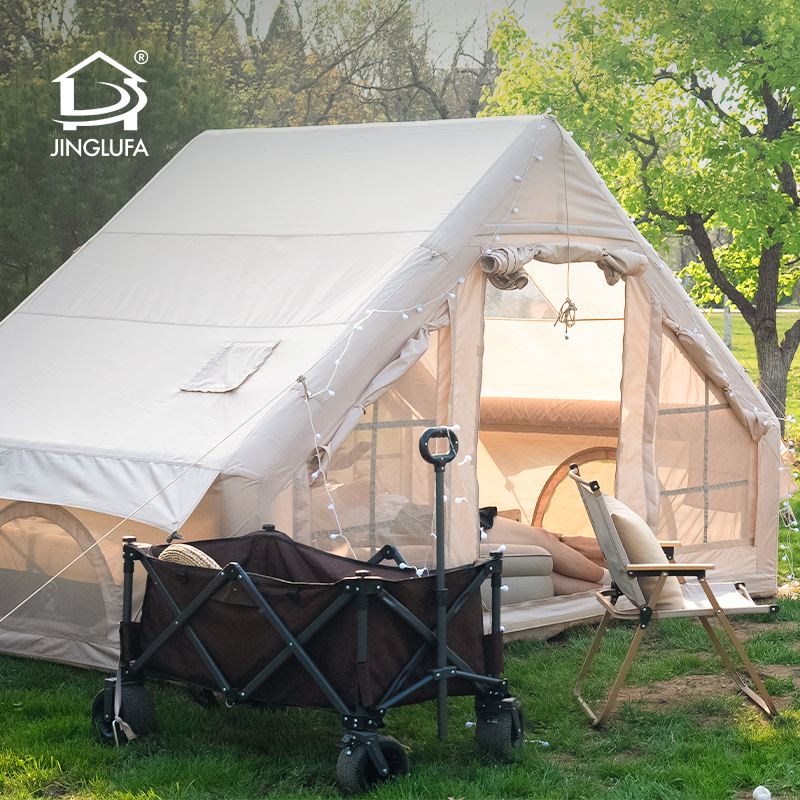
When you picture a military tent, you probably think of heavy canvas, confusing poles, and hours of manual labor. But what if a team could erect a massive shelter in minutes using little more than an air pump? That’s the game-changing reality of the modern inflatable military tent.
In disaster relief or on the battlefield, where speed can save lives, this difference is crucial. A rapid deployment shelter system bypasses the dangerous delays of traditional tents, offering immediate, life-sustaining cover when every second counts.
The secret to their incredible strength isn’t magic—it’s pressure. Think of the difference between a squishy pool float and a hard car tire. Both use air, but the tire's high-pressure inflation makes it strong enough to support a car. These tents operate on the same principle, turning flexible fabric into a rigid, load-bearing structure.
This rigidity comes from the tent’s skeleton: a network of fabric tubes called airbeams. When filled by a powerful pump, these airbeams become as solid as metal poles, creating a sturdy frame that can withstand punishing winds and heavy snow. Unlike a bouncy castle that uses a constant flow of low-pressure air, these shelters are sealed and hold their pressure for days or weeks at a time.
But what happens with a puncture? A single hole won’t cause a collapse. The airbeams are often segmented, much like the watertight compartments in a ship’s hull. A leak in one area can be isolated and patched while the rest of the tent remains standing strong, ensuring the shelter and its occupants stay safe.
The real advantage of these shelters is that they serve as building blocks for entire installations. Within hours of arrival, teams can establish fully equipped facilities like inflatable field hospitals, secure mobile command posts, critical decontamination shelter systems, and even aircraft maintenance bays.
This speed is possible due to a massive advantage in logistics. A traditional, pole-supported structure is heavy and takes up significant cargo space. An inflatable tent from the professional inflatable military tent manufacturers, however, packs down into a surprisingly small crate. This dramatically reduces its “logistical footprint”—the amount of space and weight it requires for transport. As a result, a single truck can carry the components for an entire multi-room facility, not just a single ward.
Furthermore, these shelters are modular, meaning they can be connected like LEGO bricks to create larger, customized facilities. Two small tents can link together to form a triage area, or a dozen can be connected to build a sprawling command center. This plug-and-play capability transforms a collection of tents into a functioning, mission-ready base in record time, making them a game-changer for military and disaster relief operations alike.
The next time news of a disaster breaks, look for the clean lines of a temporary shelter for disaster relief and recognize it for what it is—a tool that allows first responders to start saving lives hours, or even days, sooner.
What once looked like a simple inflatable tent military is now a symbol of modern readiness. Its true strength isn’t in the fabric, but in the precious time it saves and the lives it helps protect.